
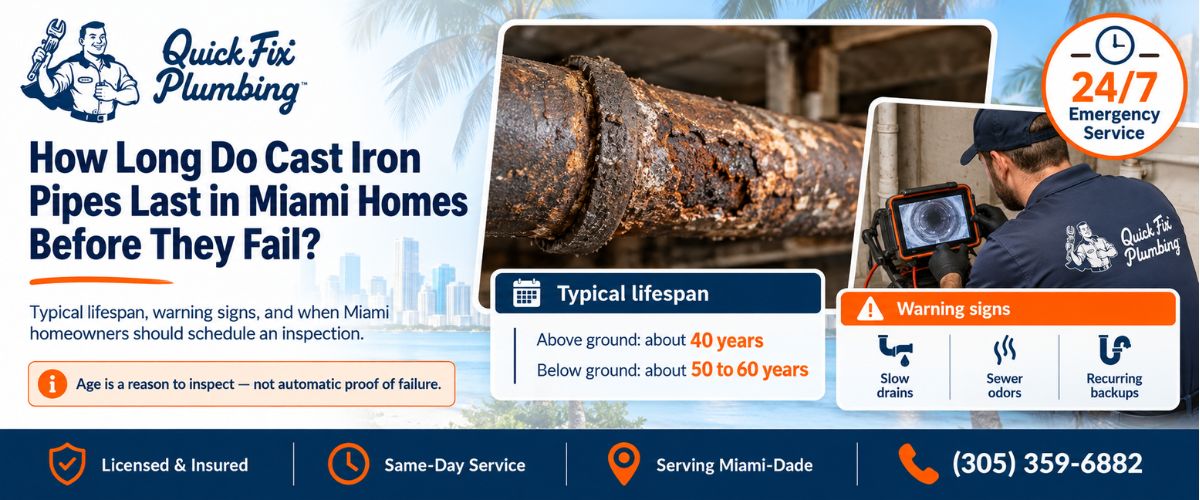
Cast iron waste pipes in Florida are estimated to last about 40 years above ground and 50–60 years below ground, according to InterNACHI’s Florida life-expectancy guidance. Actual lifespan varies with corrosion, installation, moisture, soil conditions, use, and pipe location.
For Miami homeowners, age is a reason to inspect cast iron plumbing, not automatic proof that it needs replacement.
How Long Do Cast Iron Pipes Last?
Cast iron waste pipes can remain in service for several decades. Florida-specific guidance provides these estimated lifespan ranges:
| Pipe location | Estimated lifespan |
|---|---|
| Above-ground cast iron | About 40 years |
| Below-ground cast iron | About 50–60 years |
| Favorable conditions | May last longer |
| Aggressive conditions | May deteriorate sooner |
These are general estimates rather than guaranteed replacement dates. The condition of the actual pipe matters more than age alone.
Why Do Cast Iron Pipes Deteriorate Faster in Some Miami Homes?
Pipes Under a Concrete Slab
Cast iron pipe lifespan varies because corrosion is influenced by conditions inside and around the pipe. Two Miami homes built during the same period can therefore have very different plumbing conditions.
Factors can include:
- Internal rust and scale
- Moisture
- Soil conditions
- Groundwater exposure
- Sewer-gas exposure
- Installation quality
- Previous repairs
Miami-Dade Water and Sewer corrosion guidance also identifies soil conditions, site conditions, sewer gases, and saltwater exposure as factors affecting corrosion in its iron infrastructure.
Does a 50-Year-Old Cast Iron Pipe Need Replacement?
Not necessarily. A 50-year-old cast iron pipe should be inspected more closely, but age alone does not prove that it has failed.
Replacement becomes more likely when there is:
- Widespread cracking
- Severe corrosion
- Collapsed pipe
- Multiple damaged sections
- Recurring backups
- Repeated repairs
When deterioration is extensive, cast iron pipe replacement in Miami may be more practical than repeatedly repairing isolated sections.
What Are the Signs of Failing Cast Iron Pipes?
Failing cast iron pipes often produce recurring drainage or moisture problems. One isolated clog does not prove pipe failure, but repeated symptoms deserve further investigation.
Common warning signs include:
- Recurring drain clogs
- Several slow drains
- Sewer odors
- Gurgling toilets or drains
- Visible rust or corrosion
- Damp areas near floors or walls
- Repeated plumbing repairs
If the same drainage issue keeps returning, drain line repair in Miami or further diagnosis may be needed.
Can a Sewer Camera Detect Cast Iron Pipe Problems?
A sewer camera inspection in Miami can reveal many visible problems inside accessible drain and sewer lines. It allows a plumber to inspect the pipe without immediately opening floors or excavating the property.
A camera may show:
- Cracks
- Heavy scale
- Root intrusion
- Blockages
- Standing water
- Displaced connections
- Restricted sections
- Visible corrosion
- Collapsed pipe
A camera cannot measure every aspect of pipe-wall strength, so additional diagnosis may sometimes be necessary.
When Should Older Cast Iron Pipes Be Inspected?
Older cast iron should be considered for inspection when its condition is unknown or plumbing problems keep returning. There is no universal age at which every cast iron system must be inspected or replaced.
Consider an inspection when:
- Pipes are several decades old
- Drain backups keep returning
- Several fixtures drain slowly
- Sewer odors persist
- Repairs are becoming frequent
- You are planning a major remodel
- You are buying an older Miami home
Are Permits Required for Cast Iron Pipe Replacement in Miami-Dade?
Repair may be suitable when damage is limited and the remaining pipe is structurally serviceable. Replacement becomes more practical when deterioration affects multiple sections or repairs continue to fail.
Repair may make sense when:
- Damage is localized
- Only a short section is affected
- The remaining pipe is structurally usable
Replacement may make more sense when:
- Several sections are deteriorated
- Cracking is widespread
- Parts of the pipe have collapsed
- Repairs keep failing
- Damage extends through much of the system
The decision should be based on the extent and condition of the damage, not pipe age alone.
Can Cast Iron Pipes Be Repaired Without Digging?
Sometimes. Structurally suitable pipes may qualify for internal restoration or trenchless pipe repair in Miami.
Trenchless methods may reduce:
- Excavation
- Floor removal
- Landscaping disruption
- Surface restoration
Severely broken or collapsed sections may still require conventional replacement.
What Happens When Cast Iron Pipes Fail?
A failing cast iron pipe can cause increasingly serious drainage and leakage problems. Waiting until a line collapses may also limit the repair options available.
Possible problems include:
- Sewer backups
- Slow drainage
- Leaks
- Sewer odors
- Restricted flow
- Collapsed sections
- More extensive demolition or excavation
Repeated warning signs should be investigated instead of continually treating the same symptom.
What If Cast Iron Pipes Are Under a Concrete Slab?
Under-slab cast iron is harder to evaluate because the pipe cannot be viewed directly from inside the home. A sewer camera can help inspect accessible sections before demolition or replacement is considered.
Miami-Dade County also has specific plumbing permit requirements for sanitary-line replacement when its jurisdiction applies.
Should You Inspect Cast Iron Before Buying an Older Miami Home?
Yes, particularly when the plumbing material or replacement history is unknown. A real estate plumbing inspection in Miami with a sewer scope can provide information that may not be visible during a standard visual inspection.
It may identify:
- Pipe material
- Internal deterioration
- Root intrusion
- Blockages
- Damaged sections
- Areas needing further investigation
This gives buyers more information about the plumbing condition before closing.
Frequently Asked Questions
How long do cast iron sewer pipes last?
Florida-specific guidance estimates about 40 years for above-ground cast iron waste pipe and 50–60 years for below-ground pipe. Actual lifespan can be shorter or longer depending on pipe condition and environmental factors.
Can cast iron pipes last longer than 60 years?
Yes. Some cast iron can remain serviceable beyond estimated lifespan ranges when conditions are favorable, but age alone cannot tell you whether an older pipe is still in good condition.
Does old cast iron always need to be replaced?
No. Localized damage may sometimes be repaired, while widespread cracking, collapse, or severe deterioration may make replacement more appropriate.
How do you know if cast iron pipes are still good?
Look at the pipe’s age, plumbing history, symptoms, visible condition, and inspection findings together. A sewer camera can provide useful information about accessible sections inside the line.
Is trenchless repair possible for cast iron pipes?
Sometimes. The pipe must have enough structural integrity for the restoration method being considered; collapsed or severely damaged sections may require conventional replacement.
How Do You Know How Much Life Your Cast Iron Pipes Have Left?
There is no reliable way to calculate an exact number of years remaining from pipe age alone. The best way to assess older cast iron is to consider its age, symptoms, repair history, and current physical condition together.
If your Miami home has older cast iron, recurring backups, slow drains, sewer odors, or an unknown plumbing history, Quick Fix Plumbing can inspect the system and help determine whether repair, restoration, or replacement may be appropriate.
Explore cast iron pipe services throughout Miami-Dade or schedule an inspection to understand the condition of your plumbing today.
