
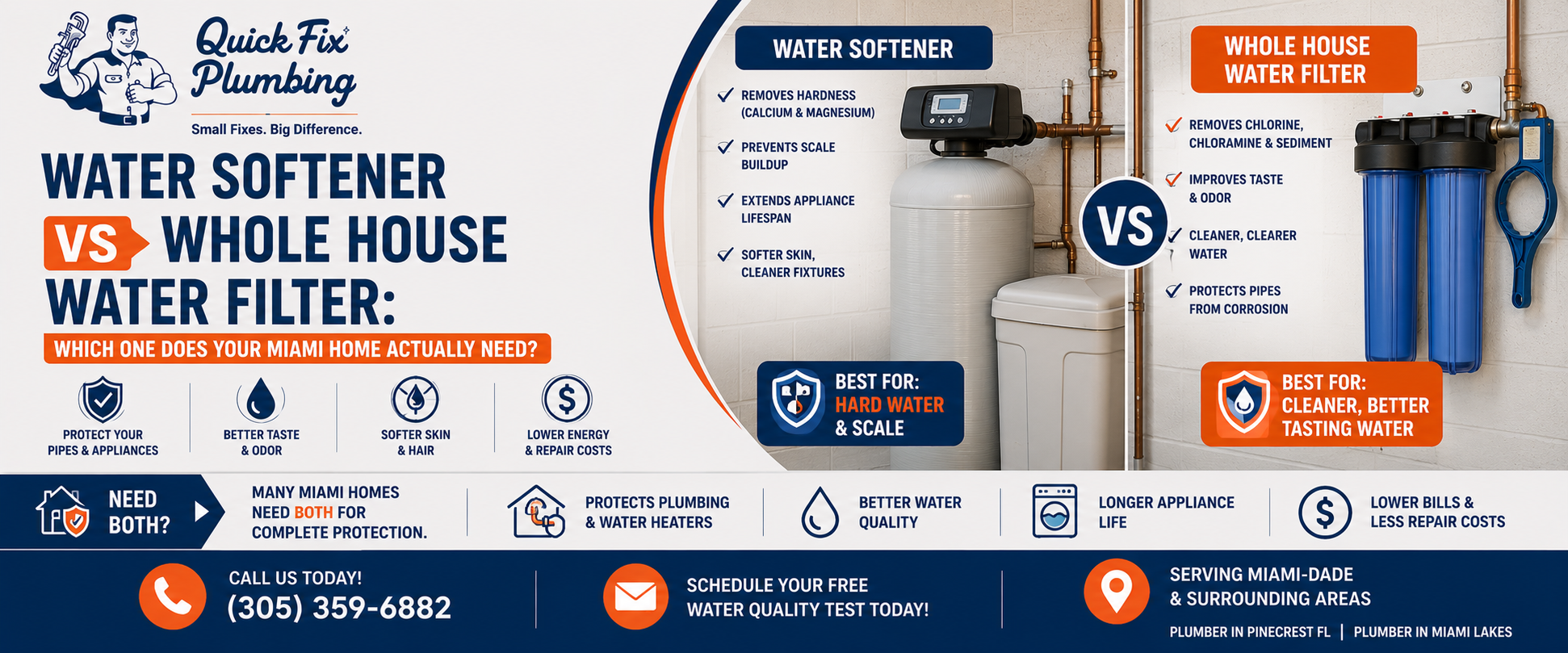
A water softener removes the calcium and magnesium that make Miami’s water “hard,” while a whole-house water filter removes chlorine, sediment, and other contaminants. They solve two different problems, and most Miami homes are dealing with at least one of them. If your issue is scale, soap scum, and appliance damage, you need a softener; if it’s chlorine smell, cloudy water, or taste, you need a filter, and plenty of homes here genuinely need both.
If you’ve ever noticed a white, crusty film building up around your faucets, a faint pool-like smell coming from your shower, or your water heater struggling to keep up as it used to, you’re not imagining things. Miami-Dade’s municipal water is treated to meet EPA safety standards, so it’s safe to drink, but “safe” doesn’t mean it’s easy on your plumbing, your skin, or your appliances. Homeowners across Miami ask us this question constantly, and the honest answer depends entirely on what’s actually in your water. In this guide, we’ll explain exactly what each system does, how to tell which one your home needs, and how a professional plumber in Miami Lakes can help.
What Is a Water Softener, and What Does It Actually Fix?
- What it removes: Calcium and magnesium minerals through a process called ion exchange, where hard minerals are swapped for sodium (or potassium) ions.
- What it protects: Pipes, water heaters, washing machines, dishwashers, and fixtures from scale buildup and premature wear.
- What it doesn't do: Remove chlorine, bacteria, sediment, or other contaminants; a softener is not a purification system.
- Signs you need one: Soap that won't lather, spots on glassware, stiff laundry, dry skin and hair, and visible white or chalky residue around faucets and showerheads.
What Is a Whole House Water Filter, and What Does It Actually Fix?
- What it removes: Chlorine and chloramine (used by Miami-Dade for disinfection), sediment, rust particles, and certain organic compounds, depending on the filter media.
- What it improves: Taste, odor, water clarity, and skin and hair irritation caused by disinfectant chemicals.
- What it doesn't do: Soften water or remove calcium and magnesium; hardness will still be there even with a filter installed.
- Signs you need one: A chlorine or "pool" smell from your tap or shower, cloudy or slightly discolored water, concerns about brown water from tap causes, an odd taste, or sediment you can see settling in a glass left out overnight.
Water Softener vs Whole House Filter: The Core Difference in One Table
| Feature | Water Softener | Whole House Water Filter |
|---|---|---|
| Primary job | Removes hardness minerals | Removes chlorine, sediment, and contaminants |
| Fixes scale buildup | Yes | No |
| Improves taste/odor | No | Yes |
| Protects water heaters & appliances | Yes | Partially |
| Needs salt/potassium refills | Yes | No |
| Needs filter cartridge changes | No | Yes |
| Best for | Hard water damage | Chlorine, taste, sediment issues |
How Hard Water Affects Your Water Heater (Especially Tankless Units)
This is where the softener vs. filter decision stops being cosmetic and starts affecting your plumbing budget directly. Mineral buildup doesn’t just sit in your pipes; it accumulates inside the appliances that heat your water every single day.
- Scale deposits coat heating elements and tank walls, forcing your water heater to work harder to reach the same temperature.
- Reduced efficiency means higher energy bills and a shorter overall lifespan for the unit.
- A tankless water heater Miami homeowners install specifically for efficiency and space-saving can see its internal heat exchanger clog with scale faster than a traditional tank, since water moves through narrow passages designed for continuous flow.
- Left untreated, hardness buildup is one of the leading causes of premature water heater failure and costly repair calls.
Do You Need Both a Softener and a Filter?
- If you're dealing with scale, soap scum, and appliance strain and a chlorine smell or taste issue, you likely need both systems working together.
- If your only concern is hardness (great-tasting water but rings around the tub), a softener alone may be enough.
- If your only concern is smell, taste, or clarity (and hardness isn't causing visible damage), a filter alone may solve it.
- The only reliable way to know for sure is testing your actual water, since hardness levels and contaminant levels vary block by block across Miami-Dade.
How Do I Know Which One My Miami Home Needs?
- Look at your symptoms first: scale and soap scum point toward hardness, while smell and taste point toward contaminants.
- Check your appliances: if your water heater, washing machine, or dishwasher is showing premature wear, hardness is a strong suspect.
- Consider your neighborhood: older plumbing infrastructure in some pockets of Miami-Dade can compound both issues at once.
- Get your water tested before buying anything: this is the only step that actually confirms what's in your water instead of relying on symptoms alone.
Frequently Asked Questions
Does a water softener remove chlorine?
Does a whole-house filter fix hard water?
Is Miami tap water safe to drink, even if it's hard?
How do I know if my water is hard?
Final Thoughts
Start with a Free Water Quality Assessment
If your water heater is struggling, your fixtures are coated in scale, or your shower smells like a swimming pool, our licensed plumbers in Pinecrest, FL, can help you figure out what’s really going on. We offer free water quality testing across Miami-Dade, along with water heater repair and replacement, leak detection, and full plumbing service for homeowners in every neighborhood we serve.
Ready to find out what your water actually needs? Call Quick Fix Plumbing at (305) 359-6882 or book your free water quality test online today.
