
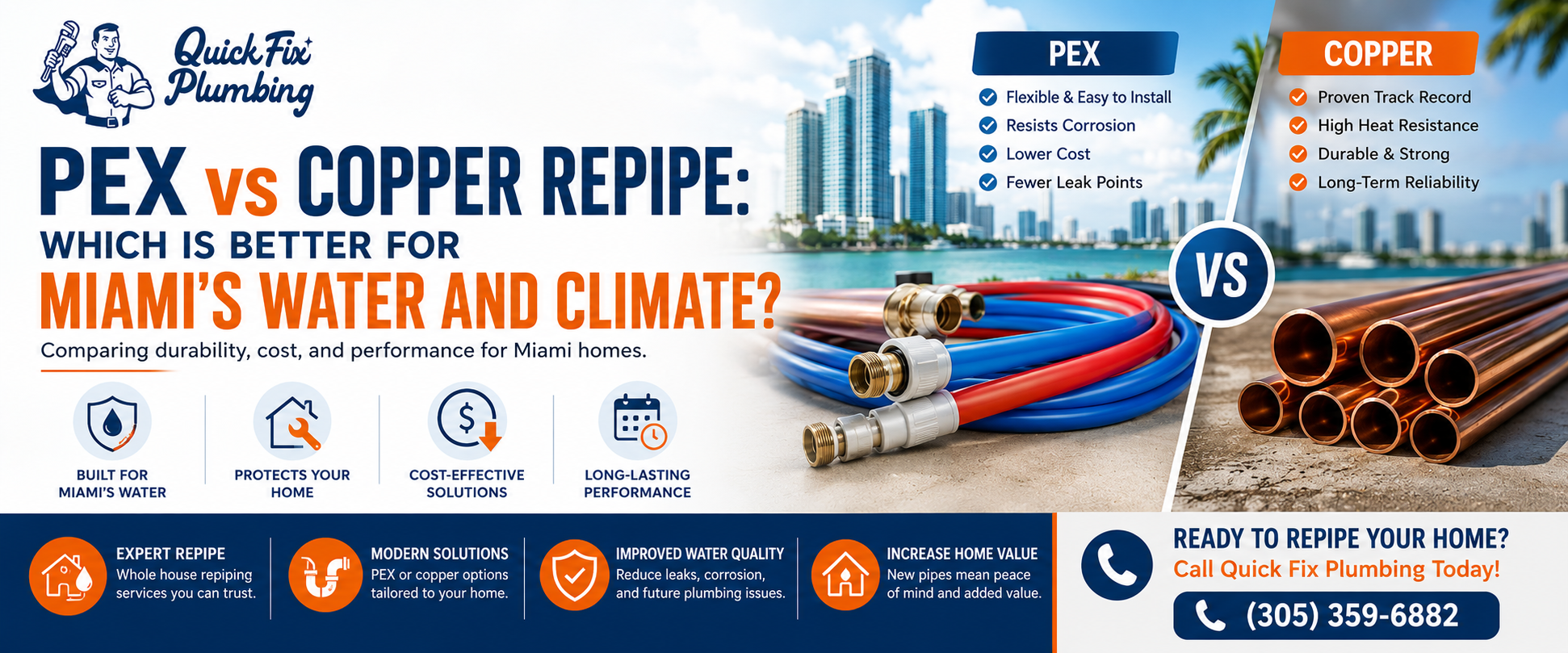
For most Miami homes, PEX piping holds up better against the corrosion caused by South Florida’s water chemistry, while copper offers a longer proven track record and higher heat resistance in specific applications. The right choice ultimately depends on your home’s age, existing plumbing issues, and budget, since both materials are code-approved and widely used across Miami-Dade. Below, we’ll explain how PEX vs. copper repipe performs against Miami’s water and climate and where one clearly makes more sense than the other.
If your home has already experienced multiple leaks or corrosion issues, this decision usually comes up during a whole-house repiping in Miami consultation, where a technician can assess your specific water conditions before recommending a material.
What's the Difference Between PEX and Copper Piping?
PEX and copper serve the same basic function, but they’re built from fundamentally different materials with different strengths and weaknesses. Understanding the core differences makes the rest of this comparison easier to follow.
- Copper: A rigid metal pipe, soldered at joints, used in plumbing for decades.
- PEX: A flexible plastic (cross-linked polyethylene) pipe, connected with crimp or push-fit fittings.
- Installation: Copper requires soldering and more rigid routing; PEX bends around obstacles with fewer fittings.
- History: Copper has been the industry standard since the mid-1900s; PEX has gained widespread adoption over the past two decades.
How Does Miami's Water Chemistry Affect Each Material?
South Florida’s water supply has specific mineral and pH characteristics that interact differently with copper than they do with PEX. This is often the single biggest factor in which material makes sense long-term.
- Copper's vulnerability: Miami's water conditions have been linked to accelerated internal corrosion in copper pipes, contributing to the pinhole leak in copper pipes issue many older homes experience.
- PEX's resistance: PEX doesn't corrode the way metal pipes do, since it isn't a reactive material in the same sense.
- Chlorine exposure: Both materials can be affected by high chlorine levels over time, though PEX is generally more resistant.
- Scale buildup: Both can experience mineral scale, but it tends to affect flow rate more than structural integrity in PEX.
How Does Florida's Climate Affect PEX vs Copper?
Beyond water chemistry, Florida’s heat, humidity, and hurricane exposure play a role in how each material performs over time. Attic installations, common in slab-foundation homes, add another layer to this comparison.
- Heat resistance: Copper handles high heat exposure, like attic installations, without concern; PEX has temperature limits that should be checked against local attic conditions.
- UV exposure: PEX degrades with direct UV exposure, so it must be installed indoors, in walls, or in attics rather than exposed outdoors.
- Humidity and condensation: Copper can sweat in humid conditions, potentially contributing to nearby moisture issues if not insulated.
- Storm resilience: Both materials perform similarly once properly installed, though PEX's flexibility can be an advantage during ground shifting or minor structural movement.
What Are the Cost Differences Between PEX and Copper Repipes?
Cost is often the deciding factor for homeowners choosing between the two, and the gap between them can be significant depending on home size and layout. Material and labor both play a role in the final number.
- Material cost: PEX is generally less expensive per foot than copper.
- Labor cost: PEX installation is typically faster due to fewer joints and easier routing, which can lower labor costs.
- Long-term cost: Copper's higher upfront cost is sometimes offset by its longer historical lifespan in well-maintained systems.
- Repair cost: PEX repairs are often quicker and less expensive than copper repairs, which typically require soldering.
Which Option Is Better If You Already Have Cast Iron Pipes?
Homes with aging cast iron drain lines face a related but separate decision, since cast iron typically affects drain and waste lines rather than supply lines. Still, many homeowners tackle both projects around the same time.
- Cast-iron pipe replacement in Miami projects is usually paired with a supply line repipe when both systems are reaching the end of their lifespan.
- Replacing cast iron with PVC is standard for drain lines, separate from the PEX vs. copper decision for supply lines.
- Doing both projects together can reduce overall labor costs compared to two separate jobs.
- A full inspection can confirm whether your cast iron and copper systems are aging on a similar timeline.
Does Your Home's Age Determine Which Material Makes Sense?
Older Miami homes and newer construction tend to lean toward different answers, mostly based on what’s already installed and how the original plumbing has held up. Age alone isn’t the only factor, but it’s a strong starting point.
- Homes built in the 1970s–1990s: Often good candidates for PEX, given typical copper corrosion patterns from that era.
- Newer homes: May already have PEX installed, making a repipe less likely to be needed soon.
- Homes with recent leak history: Especially strong candidates for switching to PEX to avoid recurring corrosion issues.
- Homes planning major renovations: A good opportunity to repipe regardless of current pipe condition.
Are There Other Water Quality Factors to Consider?
Beyond the pipe material itself, other water-related components in your home can influence which option makes the most sense long-term. It’s worth looking at the full system rather than just the pipes in isolation.
- A water heater expansion tank should be reassessed any time a repipe is done, since supply line changes can affect system pressure.
- Water pressure regulators may need adjustment depending on which material and pipe diameter is chosen.
- Existing filtration or softening equipment should be evaluated for compatibility with the new piping material.
When Should You Call a Plumber to Decide Between PEX and Copper?
This decision benefits from a professional evaluation rather than a one-size-fits-all answer, since your home’s age, water conditions, and layout all factor in. A licensed plumber can assess your specific situation before you commit to either material.
- You've had one or more pinhole leaks and want to avoid recurring repairs.
- You're planning a major renovation and want to repipe proactively.
- You're unsure whether your current pipes are copper, galvanized, or already PEX.
- You want a cost comparison specific to your home's layout and size.
If you’re searching for a plumber in Pinecrest, FL, our technicians can inspect your existing plumbing, explain your options in plain terms, and provide a clear cost comparison before any work begins.
Frequently Asked Questions
Is PEX safe for drinking water?
Yes, PEX is approved for potable water use under national and Florida plumbing codes and is widely used in residential drinking water systems.
Does PEX last as long as copper?
PEX has a strong track record so far, generally estimated at 40–50 years, comparable to copper’s typical lifespan when copper isn’t affected by corrosive water conditions.
Can I mix PEX and copper in the same repipe?
Yes, transition fittings allow the two materials to connect, which some homeowners choose for specific sections of a repipe project.
Which option increases home value more?
Both a copper and PEX repipe are viewed favorably by buyers and inspectors, since either signals updated, code-compliant plumbing over old or corroding pipes.
Conclusion
Choosing between PEX and copper depends on your home’s plumbing, water quality, and long-term goals. While PEX often performs better in Miami’s water conditions and offers lower installation costs, copper remains a durable option in the right setting. A professional inspection helps determine which material will provide the best value, reliability, and performance for your specific home.
Get Expert Advice on the Right Repipe for Your Home
Not sure whether PEX or copper is the better choice? Our experienced plumbers will inspect your plumbing system, evaluate your home’s water conditions, and recommend the most suitable repiping solution. Contact us today to schedule an inspection and receive a clear, no-obligation estimate for your repipe project.
