
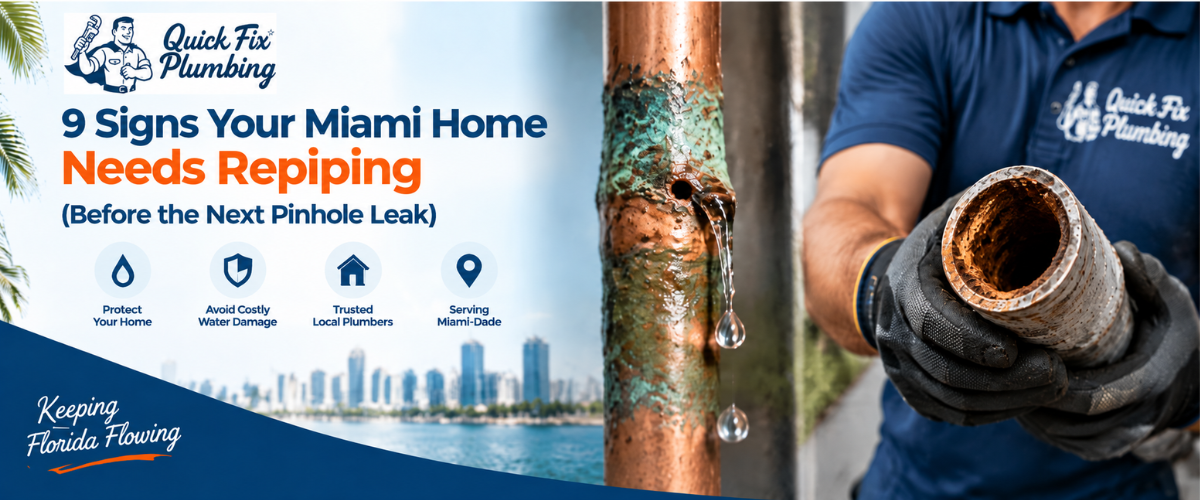
One leak is a repair; a pattern of leaks is a repipe. If your Miami home keeps springing pinhole leaks in different rooms, pours rusty water, or still runs old galvanized or aging copper pipe, the pipe material itself is likely failing — and patching one spot only delays the next. Here are the nine signs our plumbers see most, plus a simple way to tell a quick repair from a full replacement.
The 9 Signs Your Home Needs Repiping
Drain cleaning removes the gunk blocking a pipe that’s otherwise in good shape. Over months and years, grease, hair, soap scum, food waste, and mineral scale collect on the pipe walls and narrow the flow until water backs up.
A pro clears it with a drain snake or, for heavier buildup, hydro jetting that scours the pipe walls with high-pressure water. Professional drain cleaning restores full flow without touching the pipe itself, because the pipe was never the problem — it was just clogged.
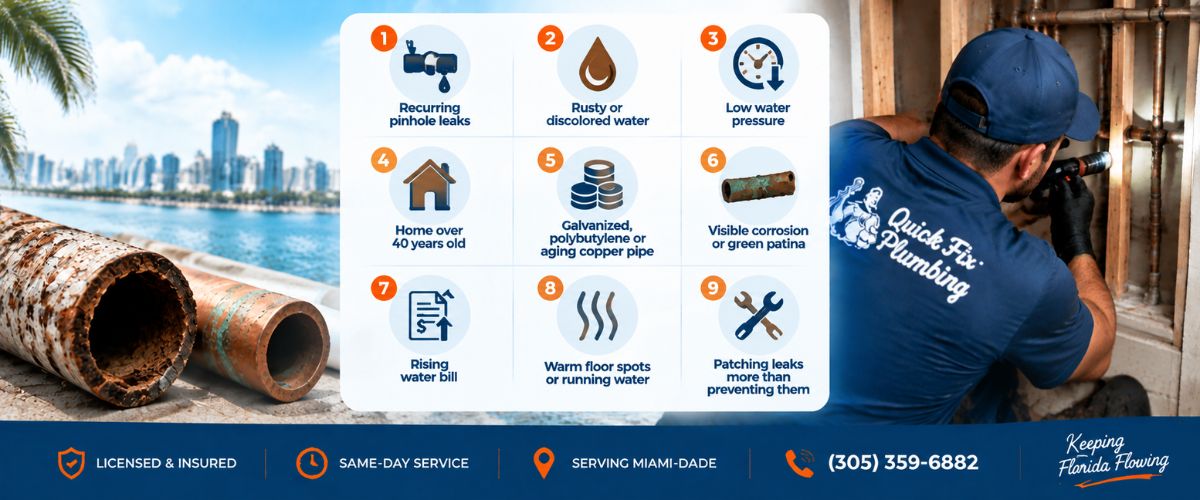
1. Recurring pinhole leaks in different rooms
Finding one pinhole leak might be bad luck. Finding three in eighteen months, each in a different wall, means the pipe walls have thinned across the whole system. That’s the clearest sign a repipe beats another patch.
2. Rusty, brown, or yellow hot water
Discolored water — especially first thing in the morning after the water has sat — usually means the pipe is corroding and shedding into your supply. If it traces to the incoming line rather than the interior pipes, water line repair may be the fix, but rust from within the walls points to repiping.
3. Low water pressure at every fixture
Weak flow at one faucet is a local issue. Weak flow everywhere means scale and corrosion have narrowed the supply lines throughout the house, and cleaning won’t reverse it.
4. Your home is over 40 years old on original pipe
Galvanized steel lasts roughly 20 to 30 years, and much of Miami’s older housing is well past that. If your home predates the mid-1980s and has never been repiped, the pipes deserve a look even without symptoms.
5. Galvanized, polybutylene, or aging copper pipe
The material itself can be the warning. Galvanized rusts from the inside, polybutylene fails suddenly, and old copper starts throwing pinholes with age. Any of these is reason enough to plan ahead.
6. Visible corrosion or green patina on exposed pipe
Green stains on copper or flaking rust on metal pipe you can see suggest the same decay is happening in the pipes you can’t. What’s visible in the garage or under a sink hints at the condition inside the walls.
7. A water bill that keeps climbing
A bill that rises while your usage stays flat usually means water is escaping behind a wall or under the slab. Precise electronic leak detection finds the source, and repeated hidden leaks across the system point straight to a repipe.
8. Warm floor spots or the sound of running water
A warm patch on the floor or water you can hear with every tap off often signals a leak in the copper lines beneath your slab. Miami’s slab-on-grade homes are especially prone, and slab leak repair or a reroute is frequently part of the repiping conversation.
9. You're patching leaks more than preventing them
Add up your plumbing repairs from the last three years. If the leaks keep appearing in new rooms and the bills keep climbing, another patch just pours money into a system that’s already failing. At that point, a whole-house repipe is usually the more cost-effective choice.
Repair vs. Repipe: How to Tell Which You Need
The line between a quick fix and a full replacement comes down to whether the pipe material is failing. Here’s the comparison:
| Spot Repair | Whole-House Repipe | |
|---|---|---|
| When it fits | One isolated leak in sound pipe | A pattern of leaks across the system |
| Pipe condition | Rest of the line is healthy | The pipe material itself is failing |
| Cost | Low per fix, but adds up if repeated | Higher once, but ends the cycle |
| How long it lasts | Until the next weak spot fails | Decades — new pipe throughout |
| Best for | Newer copper or PEX, single failure | Old galvanized, polybutylene, aging copper |
Checking off more than one sign?
Multiple warning signs usually mean the system, not just a pipe, is failing. Contact us for a repipe evaluation and an honest repair-or-replace recommendation.
Why Miami Homes Are Prone to Pipe Failure
Miami’s plumbing faces a tougher environment than most. The region’s hard, mineral-heavy water eats at copper from the inside, and coastal salt speeds corrosion on homes near the water. Both push copper toward pinhole leaks years earlier than in soft-water areas.
Slab-on-grade construction adds to the challenge, hiding leaks beneath the concrete until a warm spot or a high bill gives them away. And in older neighborhoods, homes still running original galvanized supply or aging cast iron drains are often overdue for an upgrade, whether or not they’ve leaked yet.
The Insurance Angle You Shouldn't Ignore
There’s a financial reason to act beyond the repairs themselves. Insurers increasingly deny claims — or refuse coverage entirely — on homes with polybutylene pipe or a history of repeated old-pipe failures. Some policies now ask directly whether a home still has it.
Replacing failing pipe proactively is far cheaper than fighting a denied claim after a flood. A repipe can also make your home easier to insure and more attractive to buyers, since it removes a known risk from the property.
What to Do If You See These Signs
Don’t guess, and don’t over-react to a single symptom. A plumber confirms the real picture by checking pressure at several fixtures, inspecting accessible pipe, and sometimes cutting out a small section to show you its condition.
If only one sign shows up and the inspection finds no broader pattern, monitoring and spot repairs may be fine. When several signs appear together, that’s the point to get a full repipe evaluation before the next leak forces the decision for you.
Want to protect your home before the next leak?
Contact us today for a plumbing inspection and an honest repipe recommendation with upfront pricing. Call (305) 359-6882.
Frequently Asked Questions
How many pinhole leaks mean I need a repipe?
There’s no exact number, but a pattern is the tell. Three pinhole leaks in different rooms within about eighteen months usually means the pipe walls have thinned across the whole system, which points to repiping rather than more patches.
How long do pipes last in Florida?
Galvanized steel lasts roughly 20 to 30 years, copper 50 or more but with earlier pinhole leaks in hard water, and PEX 40 to 50-plus years. Polybutylene should be replaced on sight, since it can fail without warning.
Is repiping worth it, or should I keep repairing?
If leaks keep appearing in new locations and your repair bills keep rising, repiping is usually the more cost-effective choice. A single isolated leak in an otherwise sound pipe is fine to repair.
Does hard water cause pinhole leaks?
Yes. Miami’s mineral-heavy water and coastal salt corrode copper from the inside, causing pinhole leaks years earlier than in soft-water regions, regardless of the pipe’s age.
Will insurance cover old pipe failure?
Increasingly, no. Many insurers deny claims or refuse coverage on polybutylene and repeatedly failing old pipe. Replacing it proactively protects both your home and your coverage.
Act Before the Next Pinhole Leak
A single leak is a repair, but a pattern of them is your home telling you the pipes are done. Rusty water, weak pressure, old pipe material, and rising bills all point the same direction. Catching it early — before the next pinhole leak floods a wall — saves money and stress. Our licensed Miami plumbers inspect first and recommend a repair or a repipe based on what your pipes actually need.
