
If your bathtub won’t drain but the drain looks clear, the cause is usually one of six things: a stuck stopper, a bent trip-lever linkage, a blocked plumbing vent, mineral scale narrowing the pipe, a bellied drain line, or a deeper problem in the main sewer line under your home. This guide explains each cause, gives you a quick way to tell which one you’re facing, and shows when the fix is beyond a DIY check.
First, Rule Out the Obvious
Before looking deeper, confirm the drain really is clear. Remove the stopper completely and check that no hair or gunk is caught at the opening or on the crossbars. If the drain looks clean and water still pools, the problem sits past the drain — and that’s where the real causes live.
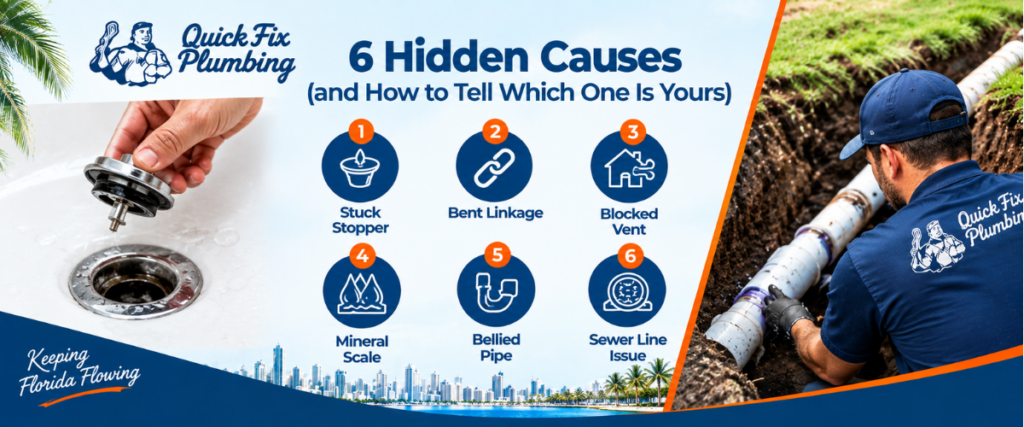
6 Reasons a Tub Won't Drain When It's Not Clogged
Finding one pinhole leak might be bad luck. Finding three in eighteen months, each in a different wall, means the pipe walls have thinned across the whole system. That’s the clearest sign a repipe beats another patch.
1. A stuck or faulty stopper
A stopper can look wide open while its internal mechanism is jammed, broken, or misadjusted, letting only a trickle through. Pull the stopper out entirely and test the drain without it. If the water rushes down, the stopper is your culprit and usually a simple fix.
2. A bent or gummed-up trip-lever linkage
On tubs with a lever on the overflow plate, the internal linkage can bend, disconnect, or gum up over time, holding the stopper partway shut. Unscrew the overflow plate, pull out the linkage, clean it, and check its full range of motion before reinstalling.
3. A blocked plumbing vent
This is the one most people never suspect. Your drains need air to flow, and a vent pipe on the roof clogged by leaves or a bird’s nest creates a vacuum that holds water in the pipe. A telltale sign is a tub that gurgles or drains in slow lurches even though nothing is clogged below.
4. Mineral scale from hard water
Miami’s hard water leaves calcium and mineral scale on the pipe walls, roughening them and slowly narrowing the drain until water crawls. If the tub has grown gradually slower over months, buildup is likely, and a professional drain cleaning clears the pipe walls that a plunger never reaches.
5. A bellied or sagging drain line
Over time, a section of drain pipe can settle into a low spot — a belly — where water and debris pool instead of flowing away. This is common in older homes and slab foundations, and it needs drain line repair to correct the slope, since no amount of cleaning fixes a sagging pipe.
6. A main sewer line problem
The most serious cause is a blockage or break downstream in the main line. The clue is that more than one drain slows at once, or your toilet gurgles when the tub empties. When that happens, sewer line repair addresses the shared line the whole house relies on.
The Self-Diagnosis Flow: Which One Is It?
Use these quick checks to narrow it down before you call anyone:
- Stopper won't lift fully, or the tub drains fine without it → stopper or linkage
- Toilet gurgles when the tub drains, or you hear glugging → blocked vent or sewer line
- Several drains in the house are slow at once → main sewer line
- Only this tub, and it's gotten gradually slower → mineral scale or a bellied pipe
The pattern usually points to one cause. Gurgling and multiple slow drains are the signs that mean the problem is downstream, not at the tub.
Cause, What It Means, and Who Fixes It
Here’s the full picture at a glance:
| Cause | What It Means | Who Fixes It |
|---|---|---|
| Stuck stopper or linkage | Mechanical part is jammed or bent | Often DIY; plumber if worn |
| Blocked plumbing vent | A vacuum holds water in the pipe | Plumber (roof vent) |
| Mineral scale (hard water) | Pipe walls narrowed by buildup | Drain cleaning |
| Bellied / sagging pipe | A low spot where water pools | Drain line repair |
| Main sewer line issue | Blockage or damage downstream | Sewer line repair |
Why Miami Homes Are Prone to Hidden Drain Problems
Miami’s housing makes the deeper causes more common than they’d be elsewhere. Slab-on-grade homes hide drain lines under concrete, so a bellied or sagging pipe stays invisible until the tub starts holding water.
Homes built before the 1980s often still run cast iron drains that corrode and roughen inside, catching debris and slowing flow. Add the region’s hard-water scale and tree-root intrusion into older sewer laterals, and a tub that “won’t drain but isn’t clogged” frequently traces to a pipe problem below. For stubborn buildup or roots, hydro jetting scours the line clean where a snake can’t.
Toilet gurgling or several drains slow at once?
Those signs point to a vent or sewer problem below the surface. Contact us for a proper diagnosis before it turns into a backup.
Safe DIY Checks (and What to Avoid)
A few checks are safe to try yourself before calling a pro:
- Remove and clean the stopper, then test the drain without it
- Inspect the trip-lever linkage behind the overflow plate
- Listen for gurgling and check whether other drains are slow too
What to avoid: harsh chemical drain cleaners, which corrode older pipe and can turn a slow drain into a costly repair. Skip boiling water on PVC lines, and never keep forcing water down a drain that’s backing up — that can push a small problem into a messy one.
When to Call a Plumber
Bring in a professional when:
- Your fix only lasts a day or two before the slow draining returns
- A foul odor keeps rising from the drain after cleaning
- Water backs up into the tub when you flush or run another fixture
- More than one drain is slow, pointing to the main line
At that point, guessing wastes time. A camera inspection sends a scope down the line to show exactly what’s happening under your home, so the right fix happens the first time.
Want to know what's really going on under your home?
Contact us today for an honest diagnosis and upfront pricing on the right fix. Call (305) 359-6882.
Frequently Asked Questions
Why won't my tub drain if there's no clog?
When the drain opening is clear but water still won’t go down, the cause is usually a stuck stopper, a bent trip-lever linkage, a blocked plumbing vent, mineral scale in the pipe, a bellied line, or a main sewer line problem downstream.
Why does my toilet gurgle when the tub drains?
Gurgling means air is being pulled through the system, which points to a blocked plumbing vent or a partial blockage in the main sewer line. It’s a sign the problem is downstream, not just at the tub.
Can a blocked vent really stop a tub from draining?
Yes. Drains rely on air to flow. When a roof vent is clogged, it creates a vacuum that holds water in the pipe, so the tub drains slowly or in lurches even with a completely clear drain.
Is a slow tub a sewer line problem?
It can be. If several drains are slow at once or the toilet gurgles when the tub empties, the main sewer line is the likely cause and needs professional diagnosis.
Should I use chemical drain cleaner on a slow tub?
No. Chemical cleaners corrode older pipe and rarely fix a non-clog cause like a vent, linkage, or bellied line. They can turn a minor slowdown into an expensive repair.
Get to the Bottom of a Tub That Won't Drain
A bathtub that won’t drain but isn’t clogged is usually telling you the problem is deeper than the drain opening — a stopper, a vent, scale, a sagging pipe, or the sewer line. The quickest path is to run the simple checks, and if the tub still won’t empty, let a pro confirm what’s happening below. Our Miami plumbers diagnose the real cause and fix it right, without harsh chemicals or guesswork.
